- Sections :
- Business
- Crime & Public Safety
- Local Area
- More


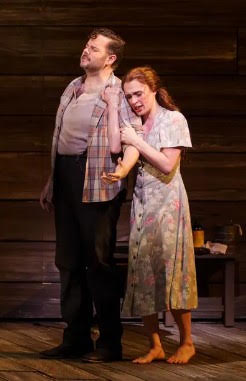
HOUSTON, TX -- The American Spirit. It’s found everywhere, all over the nation, but especially in the Appalachian Hills, where folk songs and hymns take to the ascents, and are reflected upon the great opera houses of Our County, with the Houston Grand Opera counted amongst them. From 1935’s ‘Porgy and Bess,’ to dare it be said, 2014’s ‘Bum Phillips,’ American-based opera is a masterpiece of ingenuity, born of a more youthful and less formal spirit to that presented by our European cousins, yet it brings a more rustic feel to the stage, a representation of the vast expanse of our land, allowing for a genuine warmth felt amongst the audience and more ownership in what is being presented on the stage. The Houston Grand Opera’s presentation of the final performance of on November 8th, ‘Susannah,’ proved itself to be a triumphful tale of innocence punished wrongly, but rightful in its justice at a terrible cost. Birthed from the genius of composer and librettist Carlisle Floyd in the mid-1950’s, it was based on the Apocryphal tale of ‘Susannah and the Elders,’ and has relevance in many houses of worship, where those who feel blessed in God’s spirit may take liberties with their judgement of others when it’s not their place to do so.
Susannah is a tale of Americana that is intense, dramatic, spectacular, bold, impactful, and hooks you from the word go. It captures the era to perfection in its magic and majesty, and the religious aspect is welcoming, although the Christianity presented is not yielded with grace and forgiveness, yet with a sentiment of sanction and chastisement, but with a hope for Susannah’s future; a second chance somewhere else.
With Carlise Floyd being Southern born, he was able to take what he saw and heard in the culture and adapt the ancient story of a rich Babylonian woman to that of a poor Appalachian Hills teenager, for an incredible American re-telling of the tale. He presents a piece of work that has a pleasing tune in music and in vocals reflective of the hills, a product of the people Floyd vividly remembered, and presents it in segments to an audience generally unaware that it was a story told in a biblical fashion that isn’t included in any American version of the Good Book.
Floyd’s Susannah Polk (Sylvia D’Eramo), resides with her brother Sam (Bille Bruley), who supports her with his traps in very rural Tennessee’s near mid-20th century’s New Hope Valley. At a church social, the wives of church elders look at Susannah, seeing the young woman’s beauty as dripping with the essence of evil, but have no real proof of any impropriety. Between the dances and accusations, the new Reverend to the town, Olin Blitch (Rod Gilfry) arrives a day earlier than expected, even surprising the assembled by dancing with Susannah. A day later, as elders are searching for a creek large enough for a large baptismal opportunity, they happen upon the waters where Susannah is bathing unclothed near her family’s cabin on Polk terra firma.
The elders take the innocent action of her hygiene habit as an affront, and soon spread the news to their wives which goes to the entire town. Susannah’s friend Little Bat (Aaron Blake), who can be described as mentally slow, arrives at her cabin as the Sun retreats to tell her of lies he was forced to relay about her seducing him, just more false evidence in the attempt for the elders to force the young lady from her home. At the next church meeting sounds of baptism can be heard near the Polk log cabin, at the creek Susannah baths. Sam encourages her to go to church, while he goes to check his traps. At the worship service Rev. Blitch encourages all those in attendance to approach and ask for God’s forgiveness, to which Susannah eventually does approach, but shuns Blitch’s attempt at the last minute and rushes home.
Later that night Blitch arrives at the Polk’s cabin to tell her of his loneliness, while trying to fight off his lustful intent, while Susannah, tired and emotionally drained from the mental abuse thrust upon her, surrenders to Blitch to violate her. The reverend in his lust finds truth in the girl's statement, and by morning is morally destitute and at the church testifying to the church elders and their wives, of Susannah’s innocence, which they reject. Sam soon returns from his hunt, drunk, and finds out about Blitch’s defiling of his sister, to which he charges off to kill the reverend. Little Bat soon arrives with the account of the shooting to Susannah, only to reject her friend with a vicious slap. Townsfolk arrive at the Polk land to confront the young woman, to which she rightfully threatens them with a shotgun.
Susannah is the personification of innocence in the ordeal, and her actions on her own land, cleansing herself, should have never been an issue. Unfortunately, beauty can be a curse, and for those who see it as evil, it can be a spiral into the depths of deranged minds that yield to outcomes not intended. Rev. Blitch is a complicated lonely man, attending to the spiritual needs of his flock but allows his psyche to suffer, and in the end abuses his spiritual authority in taking Susannah’s innocence. The reverend just couldn’t refuse her beauty, as if she were a siren luring a sailor, which always ends in disaster, and his plea for forgiveness is set aside with prejudice. Blitch and the elders robbed her of her joy.
The acting was superb in every respect, and the passion on stage portrayed by Tyler, Texas raised Sylvia D’Eramo was incredible to watch, and even as a young girl she spoke with a heavy twang. D’Eramo was able to easily relate to the character of Susannah, despite the immense weight of the subject matter, but with her angelic voice, she was a driving force to the innocence portrayed on stage, and devoid of fault. Her aria ‘Ain’t It a Pretty Night!’ filled the theatre to the rafters, and was absolutely stunning; and in a way foretold of Susannah’s eventual destiny.
The characters of Little Bat, Rev. Blitch, and Sam, played respectively by Aaron Blake, Bille Bruley, and Rod Gilfry, each have their flaws. Blake’s Little Bat’s betrayal of Susannah is convincing in his portrayal of a boy, slow of mind, and weak in character in allowing himself to say untrue things about his friend because of his cowardice in not protecting her, and his regret is self evident. Bruley’s character of Sam, a loyal and loving brother to Susannah, played his role as his sister’s keeper, and his tenor voice soothes his charge, but in the end fails to be there in time to prevent his sister’s violation by the reverend.
Rod Gilfry’s Rev. Blitch was extraordinary, with his baritone voice leaving its mark in the theater. His performance was so effective that the loathing of his character persisted into the curtain call before it was accepted by the audience. To say he was convincing is an understatement.
The Elders and their Wives were excellent supporting characters, along with the chorus, in their rush to condemn Susannah, and together their voices along with principals and chorus, made a wonderful afternoon’s entertainment despite the melancholic ending presented.
Many congratulations are called for, from HGO’s third annual recognition of Active and Veteran members of the U.S. Armed Forces, at the final performance as Veterans Day approaches, to Our National Anthem, with audience members' operatic voices making the moment ever so special.
So where to start? Chorus director Richard Bado’s command of his vocalists in maintenance of their volume, color, and texture, set the right moods and feelings that brought a deep emotion to the audience, even into the bows. Scenic and Projection Designer Erhard Rom was awesome in setting the right atmosphere and setting for the Appalachian Hills, the screen projections allowing transparency of action on the stage, and opposite to its opacity is remarkable, and enjoyable to view.
Conductor James Gaffigan did wonderful work with his orchestra in setting the mood while marking the score of the various themes presented; and Director Patricia Racette’s work, in bringing everything together, properly alerting the audience to the concentration of heinous behavior, especially when the chorus’ focus was tightly aimed at the principals especially, particular during the opening dance, the trial of Susannah, and the finale. Racette’s influence made for a most wonderful experience in putting together a truly wondrous afternoon of entertainment.
The Houston Grand Opera’s production of Susannah is a testament to its professionalism which makes it among the best opera houses in the United States. Carlisle Floyd’s connection to the HGO and the University of Houston, is special in that he founded the HGO Studio in 1977, and collaborated with the HGO for almost 50 years, with Susannah performances dating back to 1972, 1976 and 1996. Let’s hope that Susannah’s next visit doesn’t take another 30 years.
